

The Workflow
Let’s run a thought experiment and define a framework for efficient agent collaboration. You might ask: why? Because the goal is not just to memorize a recipe. It is to understand why things are structured this way so you can build your own understanding and experiment on your own. This matters because the framework we arrive at is a baseline, not a silver bullet.
So let’s start by defining what such a framework operates on.
Threads and context
Section titled “Threads and context”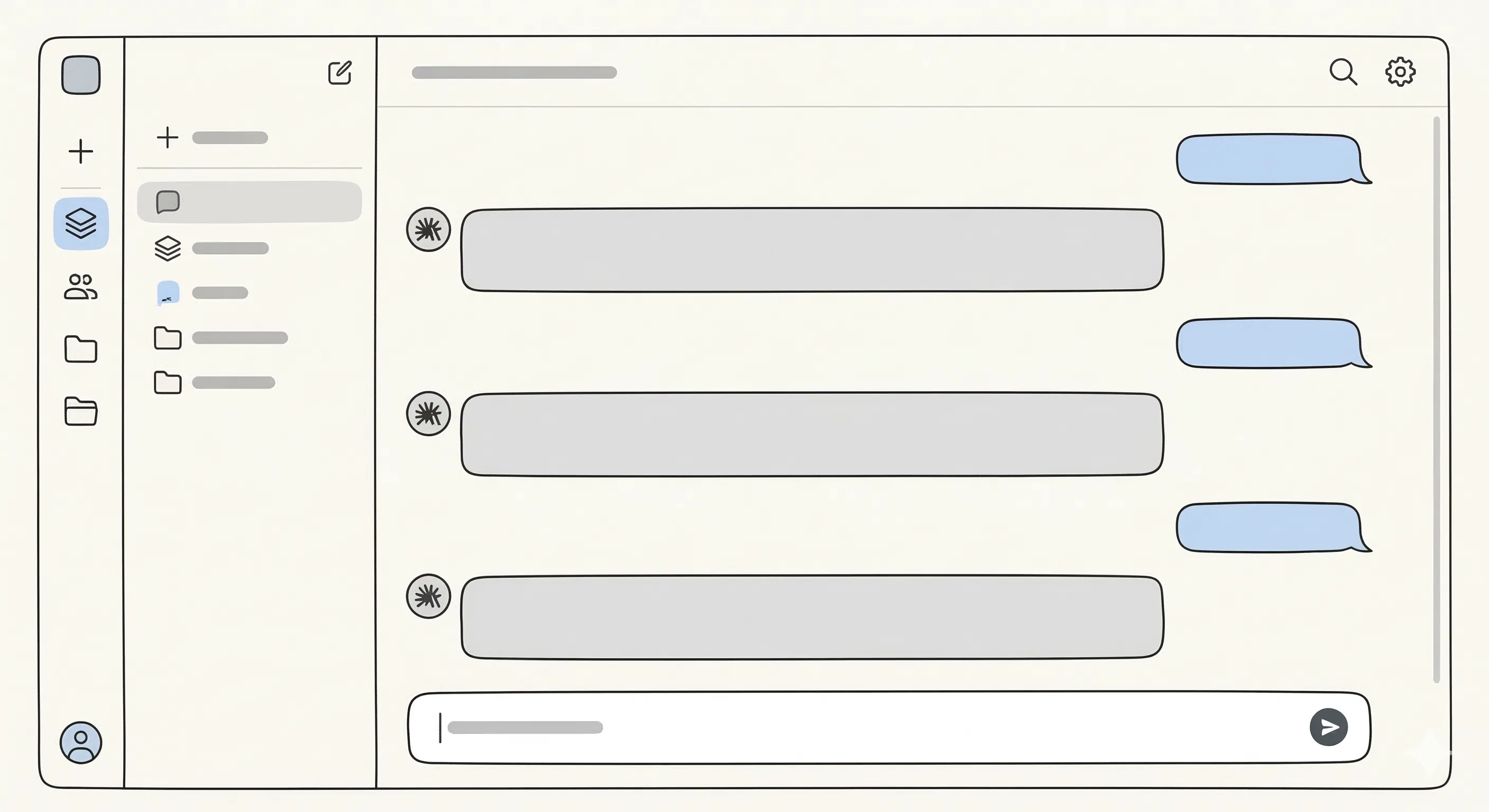
The primary unit of work with agents is a thread. In a nutshell, it’s just a conversation between you and an agent. We go deeper into how threads are implemented in the next chapter.
For each thread, we can reason about what the model knows at a given moment. This knowledge splits into two parts:
- The information the model has been trained on. We call this model knowledge.
- The entire contents of the current thread, all past messages within it, and the space for future ones. We call this context.
Obstacles
Section titled “Obstacles”Now that we know the tool we are working with, let’s look at the biggest challenges we face when working with agents.
Source: Augmented Coding Patterns Lada Kesseler et al. 2026-03-11
Knowledge cutoff
Section titled “Knowledge cutoff”The model’s built-in world knowledge is frozen at training time, so it may miss recent APIs, tools, and practices. It also knows nothing about your private codebase until you put that information into context.
Agents cannot learn (yet)
Section titled “Agents cannot learn (yet)”Models do not get better at your project just because you told them yesterday that a task should be done in a better way. What looks like memory is usually the coding agent replaying prior context, which means preferences disappear when the session resets or earlier instructions fade out. That means the same mistake can reappear, so durable improvement has to live in prompts, docs, lints, tests, and tooling rather than in the model itself.
Context rot
Section titled “Context rot”Context degrades as a thread grows, and earlier instructions gradually lose influence long before you hit the hard context window limit. The conversation can still feel productive while important guidance is already being ignored, weakened, or contradicted. Over time, long-running threads become less reliable and need resets, summaries, or checkpoints to stay sharp.
Non-determinism
Section titled “Non-determinism”Agent outputs are not fully repeatable, so the same prompt can produce a strong result, a weaker one, or a wrong turn on a later retry.
Human-model misalignment
Section titled “Human-model misalignment”An agent can look aligned while silently building the wrong mental model of your intent. Because its reasoning is mostly hidden and it is trained to be helpful, it often complies with unclear or flawed instructions instead of pushing back. Left unchecked, misunderstanding can stay invisible until the output breaks and you become frustrated.
Context is a scarce resource
Section titled “Context is a scarce resource”Context is limited twice: only so much information fits in the window, and the model can attend well to only so much of that information at once. As you load more code, rules, plans, and history, some of it must be dropped and the rest competes for attention, especially in large multi-step tasks. For that reason, broad, complex prompts often underperform smaller, focused ones even when the nominal context window is huge. This is also why the phrase “use small threads” is repeated like a mantra.
An ideal thread
Section titled “An ideal thread”OK, so we know the tool, a thread, and we know the problems that come with it. In each ideal thread, we need to align the agent’s knowledge with our understanding and expectations, so we need to prepopulate the context with the right information. Each ideal thread also needs verification if we want satisfactory results, so we need some post-validation steps.
That suggests an ideal agent thread has an internal structure. It naturally breaks into several steps.
This is a baseline workflow for collaborating with coding agents effectively. Treat it as a default shape for substantial work, not as a rigid recipe. Depending on your intent, some phases can be merged, shortened, or skipped.
-
Plan or Brainstorm - converse with an agent about how a task (or a part of it) can be done. The goal here is to gather information and collect it in one place. Or try plan mode and work out a solid implementation outline with an agent. Talk to it and refine the plan until it’s 👌.
-
Execute - when your agent (not you!) knows how the task should be done, tell it to do it!
-
Agent review - many coding agents have built-in auto-review features. Try using them in the background so the agent spends time finding all the stupid mistakes, not you (you should be doing more valuable work in the meantime). We will discuss this in more detail later on.
-
Human review - ultimately, you (a human) are responsible for the code. Invest some time in reviewing it so that (a) you know what’s happening and (b) you won’t waste reviewers’ time.
-
Agent self-improvement - talk to your agent: How can you both improve your workflow? What lessons can you learn from recent work? Perhaps some AGENTS.md rule or a new skill needs to be created?
Threads are composable
Section titled “Threads are composable”OK, so now we know how to structure work inside a single thread. Are there any tricks for handling work across threads? Yes. Try to think of threads as composable entities. You can, and should, split work into multiple threads.
For example, most coding agents assign unique IDs to threads.
You can use these IDs to resume past threads or to fork them or hand them off into new threads.
Such forks can even be run in parallel.
Some tools allow you to refer to past threads directly (for example @Past Chat in Cursor or @@ in Amp).
If your coding agent of choice does not provide such niceties, you can always fall back to sharing context through plain Markdown files.
For example, you can run several brainstorming sessions, each on a different topic, and produce summary *.md files as outcomes.
Then, in the execution thread, you join all of that information when priming the context.